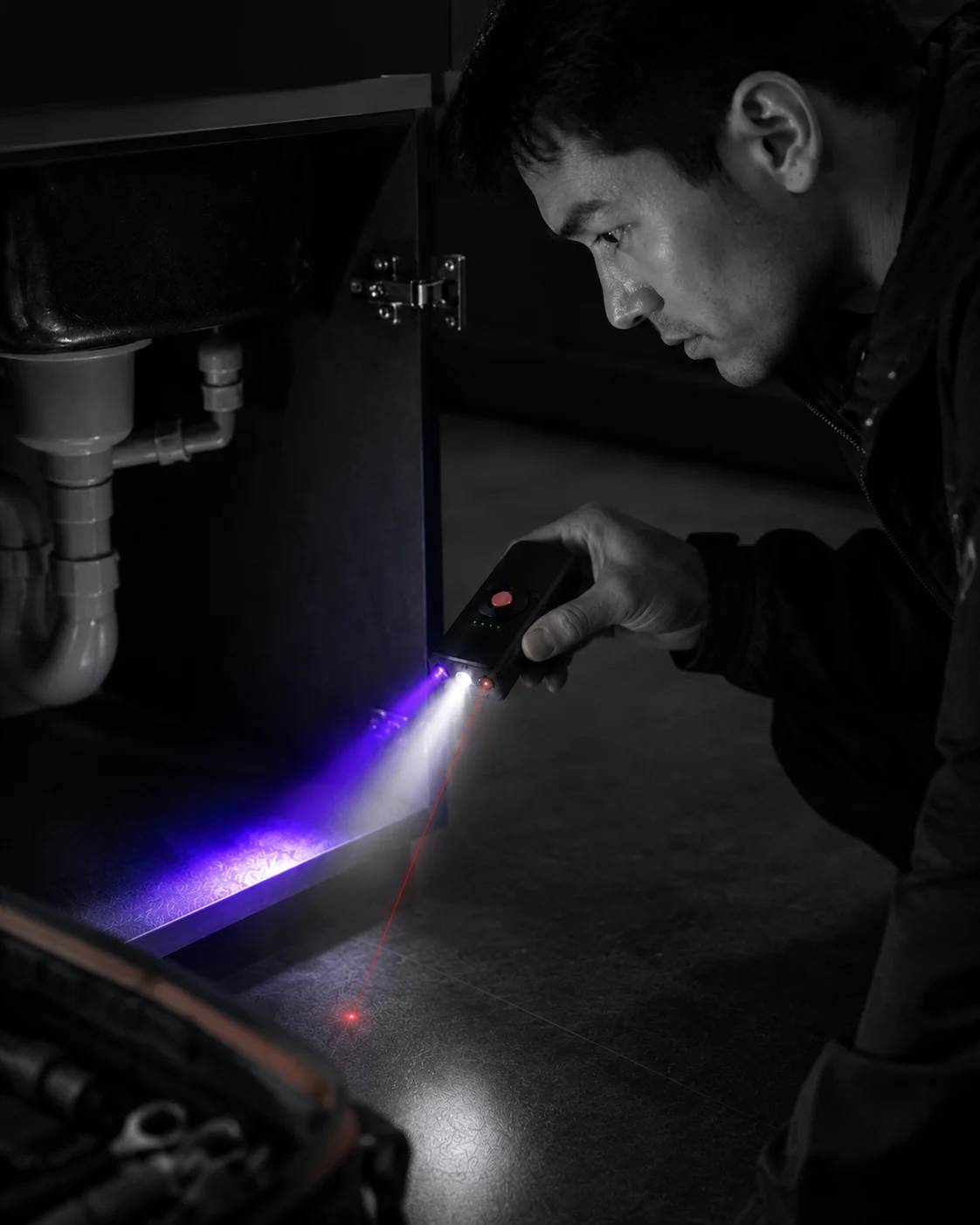


Multi-functional corner flashlight meets the needs of different scenarios.
In confined spaces, behind equipment, or in low-light environments, ordinary straight flashlights often cannot reach the areas that need to be seen. Multi-functional corner flashlights meet the needs of different scenarios and are designed specifically to address these lighting pain points: through a corner-shaped lamp head and a body that is easy to operate with one hand, the light can more easily enter blind spots and bypass obstructions, providing more direct lighting support during maintenance, inspection, assembly, and emergency use.
Product Overview
These corner flashlights are portable directional lighting tools, resembling work lights more closely than traditional long-range flashlights. Based on their visible structure, they feature a black cylindrical body with an angled lamp head at the front, a circular lens and reflector at the top, and buttons on the side for quick thumb activation and switching. The body has a matte or anodized finish, and the grip area has a textured finish, making them suitable for use with gloves or oily hands.
From a practical standpoint, it addresses the issue of "light not reaching certain areas," rather than simply pursuing large-area floodlighting. This lighting method is more practical for maintenance personnel, inspection staff, and on-site operators: the lamp head can be pointed towards the target area, the handheld posture is natural, and it's easier to keep the line of sight aligned with the beam.
Key Structures and Visible Functions
Corner lamp holder
The core value of the corner structure lies in changing the direction of the light beam. When facing the interior of a cabinet, the back of pipes, machine gaps, or below a dashboard, the lamp head can direct the light to locations that are difficult for an arm or tool to reach directly. The diagram also shows directional arrows, indicating that the lamp head may have some angle adjustment capability; however, the specific range of rotation is not specified, and it cannot be inferred that it is a fixed 90°, 180°, or other angle.
Side switch and one-handed operation
The side-mounted buttons facilitate one-handed operation and switching of lighting modes. This is crucial in scenarios where you need to hold onto a component while simultaneously using tools. For example, when inspecting circuits, tightening bolts, or checking equipment nameplates, you don't have to frequently put down your tools to find the switch, resulting in higher efficiency and more stable operation.
Textured grip area
The front or middle section of the device features a textured surface designed to enhance grip. In environments with oil, sweat, rain, or low temperatures, the textured surface is less slippery than a smooth shell, making it easier to quickly pick up and put down the device.
Concentrated beam
Judging from its visible light emission pattern, this product leans more towards concentrated beam output, making it suitable for spot lighting and localized inspection. It is not a typical large-area floodlight, therefore it is better suited for seeing screw holes, wiring terminals, solder joints, gaps, and surface details of components.
Possible materials and surface treatments
Judging from its appearance, the casing is most likely made of aluminum alloy or a similar metal, with anodizing or similar surface treatment, resulting in a more stable feel and better durability. Metal casings usually also benefit heat dissipation and structural strength, but the specific material, wall thickness, and internal structure cannot be confirmed solely from images.
The front lens appears to be a transparent lens or an engineering plastic cover, surrounded by a reflector/decorative border. The blue accent ring and blue button are highly recognizable visual elements, facilitating quick and easy switch location and making the product easier to distinguish in a toolkit.
Manufacturing process and assembly concept
Such products typically involve steps including metal tube machining, surface treatment, lamp holder assembly, lens mounting, and button and circuit module integration. If an aluminum alloy body is used, common processes include CNC machining, turning, chamfering, and anodizing; followed by optical component assembly and functional testing. Corner areas also need to balance structural stability and smooth rotation; therefore, the design of connectors, sealing rings, or limiting structures directly impacts the user experience.
Since the internal battery, charging port, and protective structure are not shown in the image, it is impossible to infer its charging method, protection level, or battery life. If the product is intended for outdoor, humid, or high-frequency operation, these parameters should be confirmed with the supplier before purchasing.
Applicable Scenarios
Car repair and maintenance
The engine compartment, chassis edges, under seats, and inside the dashboard are typical lighting challenges. Corner-style light heads can bypass component obstructions, helping to view wiring, clips, oil line connections, and fasteners.
Mechanical equipment inspection
Equipment operating areas, cabinet interiors, transmission components, and narrow maintenance access areas often require localized supplemental lighting. These types of flashlights allow inspection personnel to quickly determine whether there is looseness, leakage, wear, or foreign objects in confined spaces.
Electrical and cabinet operations
The directionality of light beams is crucial inside distribution boxes, control cabinets, terminal blocks, and cable trays. Corner lamp holders are better at illuminating components deep inside, while also reducing the problem of arm shading.
Storage, emergency and portable lighting
It can also be used as a portable work light during power outages, night shifts, temporary item searches, or operations in confined warehouses. Compared to bulky lighting equipment, its portable design makes it easier to fit into a pocket, tool bag, or vehicle storage compartment.
What should be the focus of quality control?
When purchasing these types of lamps, it is recommended to focus on several key aspects. First, check whether the lamp head rotates smoothly and has sufficient positioning to prevent it from shifting during use. Second, check whether the button feedback is clear, especially whether it can be pressed accurately when wearing gloves. Third, check whether there is any obvious looseness at the body connection. Fourth, check whether the light spot is stable and whether there is any obvious flickering after lighting. Fifth, check whether the surface treatment is uniform and whether there are any scratches, burrs, or assembly gaps.
If the product will be used in professional maintenance scenarios, batch consistency should also be confirmed, including consistent appearance color, button feel, lamp head angle, and the absence of abnormal noises after assembly. For branded procurement, these details directly affect the end user's trust.
Customization suggestions and procurement considerations
If you are a distributor, engineering procurement agent, or tool brand owner, customization typically revolves around several aspects: body color, button color, surface texture, brand silkscreen printing, packaging format, and accessory combination. For clients needing to enter specific industries, design items such as lamp head angle, grip length, beam concentration, and switch position can also be discussed based on actual workstation requirements.
When choosing a flashlight, consider answering these four questions: Do you need to operate it with one hand? Will you frequently use it in confined spaces? Is it more for spot checks than wide-area illumination? Do you need the durability of a metal casing? If the answer is mostly "yes," then this type of corner flashlight is generally more suitable than a traditional stick flashlight.
Why these types of products are suitable for professional buyers
Professional buyers often look beyond just brightness; they consider whether the tool truly improves their workflow. The advantages of a corner design include more flexible light direction, a more natural operating posture, and greater adaptability to environmental obstructions. For those who frequently perform equipment maintenance, installation, debugging, and troubleshooting, it enhances accessibility, not just lighting levels.
From its visible appearance, this product balances compactness, ease of use, and directional lighting capabilities, making it a suitable candidate for a work light, inspection light, or portable emergency light. If your project requires a multi-functional corner flashlight to meet different scenario needs , it is recommended to confirm the size, battery life, power supply method, and protection parameters before making a final selection.
Get more product information
If you are looking for a stable solution for car repair, equipment inspection, cabinet operations, or portable emergency lighting, please provide your usage scenarios and procurement requirements. We can then assist you in developing more suitable configuration suggestions, appearance customization options, and packaging solutions.