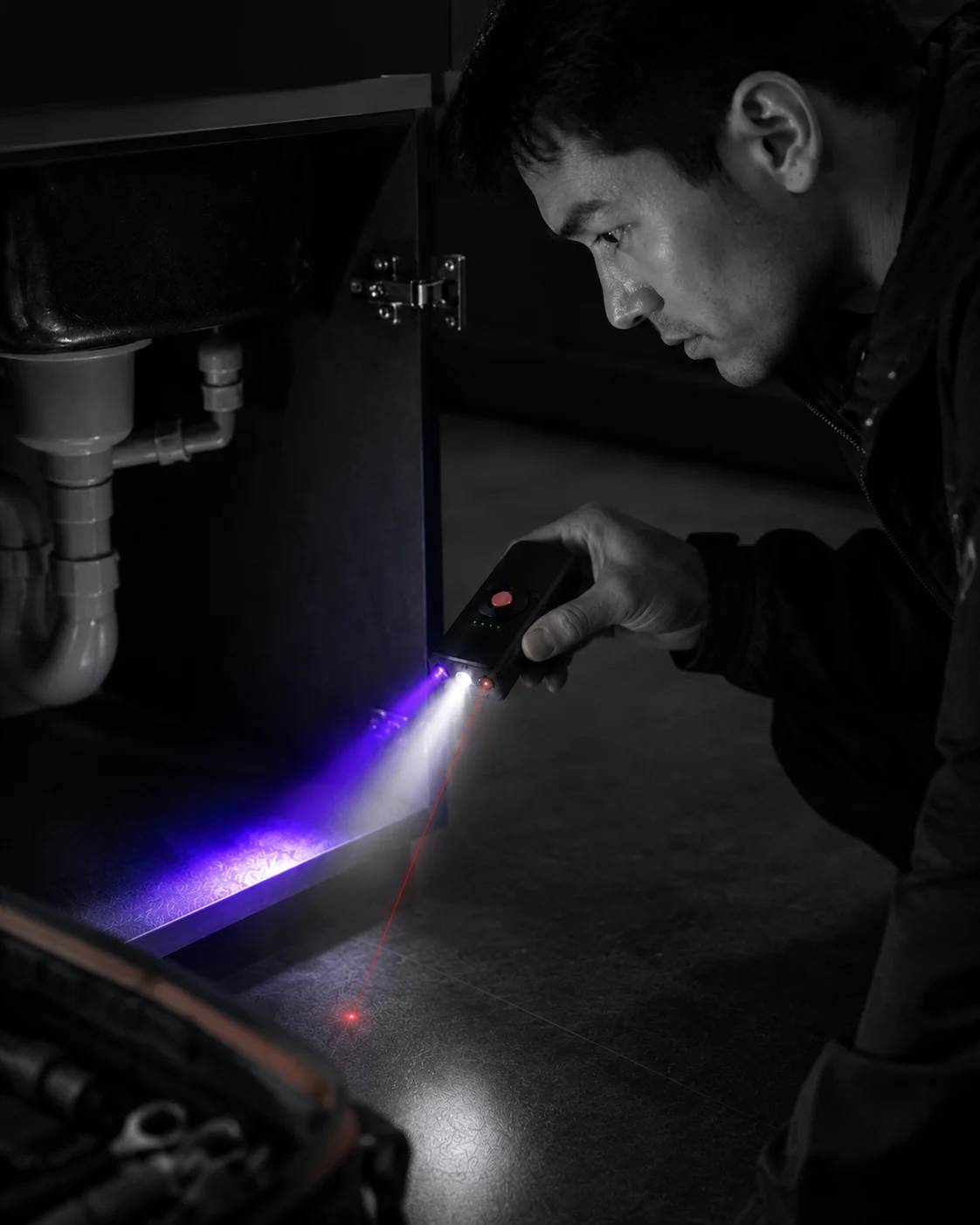


A three-in-one professional light source meets various lighting needs: a multi-functional inspection tool suitable for confined spaces.
This 3-in-1 professional light source meets various lighting needs, solving on-site problems such as "inability to see clearly, inability to illuminate, and inaccurate marking." Whether under a sink, inside a cabinet, behind equipment, or in other poorly lit, confined areas, this handheld multi-light source inspection tool provides more direct lighting, positioning, and observation conditions. For users who need to quickly find leaks, verify installation locations, conduct close-range inspections, or make simple markings, it is more flexible and suitable for switching between multiple scenarios than a single white light flashlight.
Product Overview
From its visible appearance, this is a compact handheld electronic lighting tool with a black body and a matte or semi-matte finish, making it easy to hold and reducing glare. Multiple light-emitting units are visible at the front, producing a combination of purple/UV-like beams, white light, and red laser dots or beams. Buttons and indicator areas are also visible on the top or side, indicating that it has basic handheld control functions, suitable for one-handed operation when opening cabinets, probing gaps, and inspecting surfaces close to the surface.
These products are typically used for rapid observation in low-light environments. In confined spaces, traditional headlights can easily produce shadows, glare, or insufficient illumination angles; however, a multi-light source structure allows users to switch between different modes depending on the task, providing white light illumination, purple light to assist in observing specific surface features, and red laser for positioning or indication. For maintenance personnel, installers, property inspectors, and users requiring detailed observation, it is a more practical portable tool.
Core Functions and Usage Value
1. White light illumination: meets daily viewing needs.
White light mode is typically used for general lighting, such as inspecting the internal structure of cabinets, identifying pipework layouts, confirming the location of connectors, or locating small, fallen parts. Compared to fixed light fixtures, handheld tools offer the advantage of allowing for easy adjustment of angle and distance, making it easier to deliver light accurately to the target area.
2. Purple/UV sample light source: suitable for auxiliary observation
The purple beam visible in the image may be used for auxiliary observation related to ultraviolet or near-ultraviolet light, but its specific wavelength and true optical properties cannot be confirmed by appearance alone. Therefore, it is safer to describe it as a "purple/UV-like light source" in product descriptions. This type of light can often help users more easily identify traces, residues, or specific markings on certain surfaces, making it suitable for close-range inspection scenarios. The actual effect will vary depending on the material, ambient light, and the object being inspected.
3. Red laser: Used for positioning, alignment, and indication.
The red dot indicates that the product has a laser pointer function. A red laser is valuable in confined spaces because it helps users point to a specific location more clearly for simple alignment, area marking, or visual cues. This function is especially convenient for rapid communication during installation and maintenance.
Key structural and visible specifications
Features identified from the images include: a small, handheld casing, multiple light output ports on the front, top control buttons, and a red indicator/laser output. The compact design makes it easy to carry in a pocket, tool bag, or on your person. The black casing is also more resistant to dirt in the field, making it suitable for frequent handling during daily operations.
It should be noted that specific dimensions, weight, battery type, brightness parameters, charging method, protection rating, wavelength, and operating time cannot be confirmed from the diagram, and therefore should not be written as definitive values on the page. If official parameters become available later, they can be added to the specifications table; until confirmed, it is recommended to maintain the statement "subject to the actual model".
Materials and Surface Treatment
Judging from its appearance, this type of product likely uses an injection-molded engineering plastic shell, combined with electronic lights and light-transmitting components to form a complete body. A matte or semi-matte surface helps improve grip stability and reduces specular reflections in the work environment. For users who frequently need to use the product near oily, dusty, or damp surfaces, a less glossy shell surface is a practical advantage.
For industrial or maintenance environments, the transparency or semi-transparent front light-emitting window, the button sealing design, and the way internal optical components are fixed will all affect the long-term user experience. However, these details cannot be fully confirmed in the pictures and should be described as "common structures" on the page, rather than as absolute configurations.
Manufacturing methods and product formation logic
These multi-light source handheld devices typically consist of several parts: LED or optical light-emitting components, power supply and control circuitry, switch buttons, housing, and internal mounting structure. The housing is usually injection molded, followed by assembly, lamp positioning, functional testing, and visual inspection. If a laser module is included, even stricter assembly consistency is required to ensure the light output direction and operational stability.
From a product logic perspective, it's not simply a lighting fixture that pursues brightness, but rather a composite tool designed for "lighting + positioning + auxiliary inspection." Therefore, buyers shouldn't just look at the light intensity when evaluating it, but should focus on whether the light source switching is convenient, whether the grip is stable, whether it's easy to control in narrow angles, and whether different modes can meet their on-site tasks.
Applicable Scenarios
This 3-in-1 professional light source is a tool that meets various lighting needs and is especially suitable for the following scenarios:
Firstly, inspect the area under the sink and inside the cabinet. Low-lying locations with many obstructions and poor visibility are the most common application environments. White light can be used for illumination, lasers can be used to point out problem areas, and purple/UV-like light sources can be used for further observation of surface anomalies.
Secondly, pipeline and equipment maintenance. In confined equipment rooms, corners, behind furniture, or under machines, handheld multi-light sources can help operators quickly locate connection points, cracks, stains, or loose parts.
Thirdly, installation and alignment. Red lasers are ideal for use as temporary reference points, especially when it's necessary to remind colleagues of "this location" or "this line," as the pointing effect is more intuitive than verbal descriptions.
Fourth, it allows for close-up, detailed observation. For tasks requiring inspection of gaps, corners, and edges in the dark, it is more flexible and targeted than ordinary lighting tools.
Quality control and reliability of use
For these types of electronic lighting products, buyers are typically concerned with the stability of the light output, the responsiveness of the buttons, the reliability of mode switching, and comfort after prolonged use. While specific testing data is currently unavailable, reasonable quality control usually includes visual inspection, power-on testing, function switching testing, laser alignment checks, and basic assembly checks. For higher-level field applications, further verification of housing durability, seam consistency, and circuit stability is necessary.
During the procurement phase, it is recommended to focus on confirming the following: whether the number of light source modes matches the sample, whether the laser is independently controlled, whether white and purple light can be switched separately, whether the battery and charging solution is suitable for on-site replenishment, and whether there is clear after-sales accessory support. For customers who use the product frequently, these factors are often more important than simple appearance.
Customization and Selection Recommendations
If the product is intended for B2B procurement, customization typically focuses on casing color, button layout, silkscreen printing, packaging, and light source combination. Whether customization is possible depends on actual production capabilities. For end buyers, the intended use should be clearly defined: is it just basic lighting, or is it also needed for positioning and auxiliary observation? Is it frequently used in cabinets, equipment rooms, or piping areas? Is one-handed operation and quick mode switching desired?
Three issues should be considered when selecting a laser device. First, confirm whether multiple light sources truly meet the site requirements to avoid paying extra costs for infrequently used functions. Second, pay attention to the handling experience and the device's size; a large device may hinder access to confined areas. Third, confirm that the laser function complies with local regulations and internal safety standards, especially when used in public or industrial settings.
Why are these types of products suitable for B2B buyers?
For bulk purchasing users, the value of multi-functional handheld light sources lies in "one tool covering multiple working conditions." It reduces redundant configurations in toolboxes and allows for faster workflow between different roles. Similar devices may be used in scenarios such as maintenance, property management, installation, inspection, warehousing, and detailed inspection. For companies looking to improve the responsiveness of frontline personnel, the practicality of such tools often stems from the ease of task switching, rather than a single performance metric.
Key points to confirm before procurement
Before placing an order, buyers are advised to confirm the actual functional definition of the product with the supplier: whether the purple light is for UV purposes, whether the white light and laser can work independently, what the power supply method is, whether replacement parts are available, whether bulk packaging solutions are provided, and whether brand logos are supported. If the usage environment involves humidity, dust, or frequent impacts, the body material and protective design should also be inquired about in advance. As the current information does not provide complete parameters, any specific values should be based on the official specifications or actual sample testing.
Contact us for samples and solutions
If you're looking for a handheld tool suitable for confined spaces that combines lighting, positioning, and observation, this type of 3-in-1 professional light source is worth considering. We welcome your requirements based on your application scenario, and we can further assist in confirming the appearance, feature combination, packaging, and bulk purchasing options to better suit your actual usage environment.