Product Overview
紫外线+白光+红激光 满足不同照明需求 is a practical answer for buyers who need one handheld tool to handle inspection, illumination, and simple pointing tasks without switching between separate devices. In workshops, service vans, maintenance lines, and field repair jobs, the common problem is not just lack of light; it is the need for the right kind of light at the right moment. White light helps you see surfaces clearly, UV-style light is useful for certain detection checks, and a red laser helps direct attention or mark a spot. This multi-function inspection/light device brings those functions into a compact body designed for one-hand use.
From the visible structure, the product appears to use a rugged rectangular housing with orange and black surfaces, plus a front-facing light array. The layout suggests a portable electronic enclosure built for everyday handling rather than a fixed installation. For buyers evaluating utility tools, the main value is simple: fewer items to carry, faster switching between lighting modes, and a more efficient workflow in low-light or diagnostic environments.
What the Product Is Designed to Solve
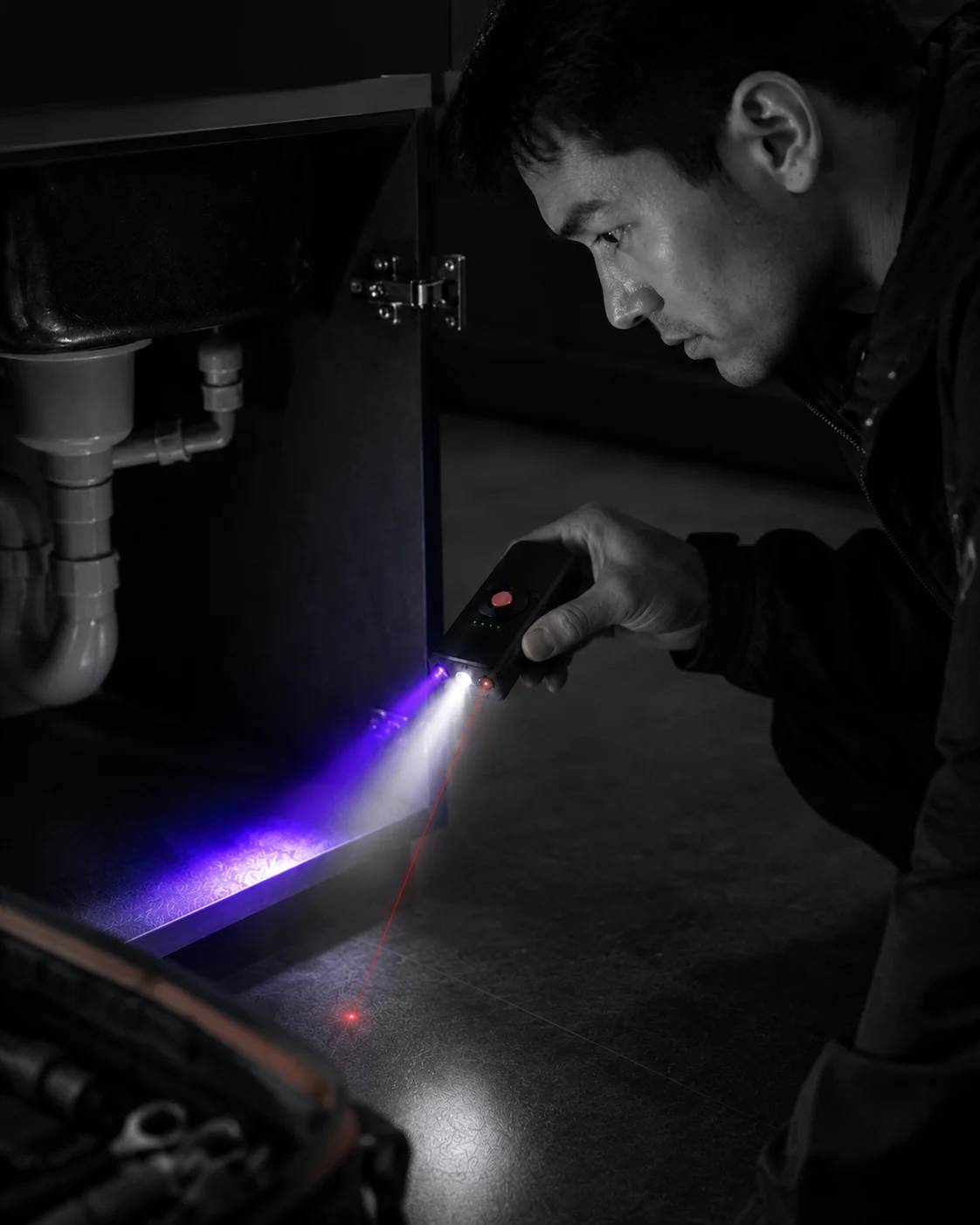
Many work environments require more than a standard flashlight. A mechanic may need white light for a general check, a red laser to point out a location on a component, and a UV-related light for tasks where fluorescence or special visibility is useful. Carrying separate tools adds clutter, weight, and setup time. This handheld device consolidates multiple lighting outputs in one unit, helping users move from inspection to pointing to close-up viewing with less interruption.
For teams that work in confined spaces, around vehicles, or in service situations where both hands are often occupied, a compact light with multiple modes can improve efficiency. It is also useful when technicians need to communicate visually with coworkers, highlight an area of interest, or verify details in dim corners.
Visible Design and Product Structure
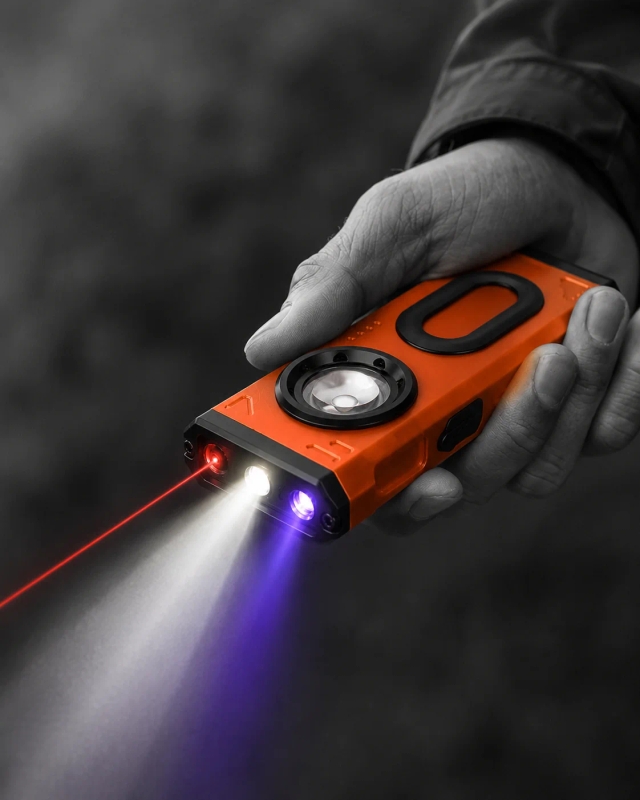
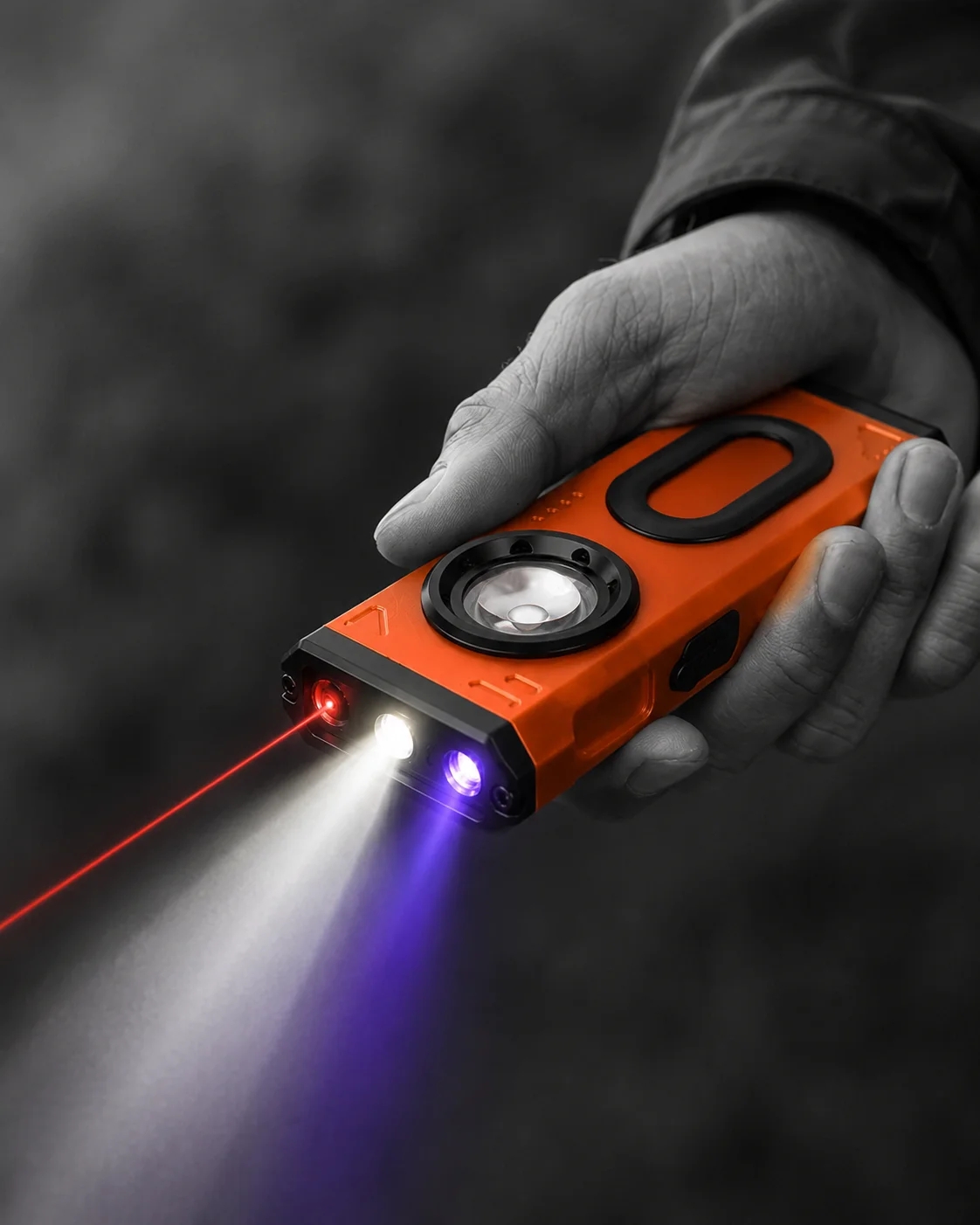
The unit shown has a rectangular orange body with black end caps and trim. That construction suggests a molded polymer or plastic enclosure, likely selected for lightweight handling and impact resistance in routine workshop use. The finish looks utilitarian rather than decorative, which is appropriate for a tool that will be set down on benches, carried in bags, or used on-site.
A large circular front lens sits on the top face, while the front end includes three separate emitters arranged across the face: a red laser pointer on one side, a white spotlight in the center, and a purple/UV-looking emitter on the other side. This separation of outputs is helpful because each mode can serve a different task without needing optical compromises in a single beam.
Because the internal electronics are not visible, it would not be accurate to claim battery type, charging method, brightness rating, or protection level. Buyers should treat those details as specification items to confirm before procurement.
Key Capabilities and Functional Use
White light for general inspection
The white spotlight is the most straightforward function. It supports close-range viewing in dark cabinets, under dashboards, along machinery edges, or inside service compartments. In practice, this mode is what users will reach for when they need clear visibility of fasteners, labels, wiring, seals, or surface conditions.
Red laser for pointing and alignment
The integrated red laser pointer is useful when a user needs to indicate a specific spot from a short distance. This can help during maintenance discussions, training, troubleshooting, or alignment-related tasks where verbal explanation alone is less efficient. It is not a replacement for measurement equipment, but it is a useful visual aid.
UV-style light for detection-related tasks
The purple-looking emitter suggests a UV-style output, though the exact wavelength is not visible and should not be assumed. In general, UV-related lights are chosen for checks that rely on fluorescence or enhanced contrast. Potential uses include inspection of marked materials, residue detection, or other specialty tasks where standard white light is less effective.
Materials and Finish Options
Based on appearance, the housing looks like an injection-molded polymer enclosure. That type of construction is common in handheld tools because it can be shaped into ergonomic forms and assembled around internal components efficiently. The visible orange-and-black color scheme also improves tool visibility on a workbench or job site, reducing the chance of misplacement.
The surface appears to have a ruggedized industrial finish, which may help mask normal wear from regular handling. Exact material grade, surface texture, and sealing features are not visible, so any discussion of chemical resistance, weather resistance, or drop protection would need confirmation from the manufacturer.
Manufacturing Process
From the outside, this product likely combines several standard manufacturing steps used in portable electronics. The enclosure would typically be produced through injection molding, followed by assembly of LEDs, optical elements, controls, wiring, and power components. The front emitter section would require careful alignment so that each light source performs as intended and does not interfere with the others.
In products of this type, assembly quality matters as much as the visible design. Good fit between the housing halves, secure retention of lenses, and stable positioning of the light modules all influence durability and everyday usability. Since the internal build is not shown, buyers should ask for assembly drawings or sample evaluation if the tool will be used in demanding environments.
Application Scenarios
This handheld multi-function light fits a wide range of work settings:
• Automotive service: under-hood checks, underbody visibility, and spot indication during diagnosis.
• Maintenance and repair: cabinet inspection, equipment troubleshooting, and parts identification in low light.
• Field service: portable lighting for on-site visits where carrying multiple tools is inconvenient.
• Workshop use: bench tasks, setup assistance, and quick visual checks during assembly or rework.
• Inspection-oriented tasks: close-up viewing, contrast-enhanced checking, and simple detection workflows that benefit from a UV-style source.
Because it combines three outputs in one unit, it is especially helpful in jobs where the lighting requirement changes several times during a single task.
Quality Control Considerations
For buyers, quality control should focus on practical function rather than just appearance. Useful checks include switch response, emitter alignment, consistent output between modes, secure fit of the lens and housing, and reliable operation after repeated handling. If the product is intended for professional use, buyers may also want to review sample units for heat behavior during extended operation and confirm whether the red laser and other emitters remain stable under normal use.
Since exact certifications and technical ratings are not supplied here, procurement teams should request compliance documents directly if the application requires them. That is especially important for regulated work environments, shipping channels, or company safety standards.
Customization Guidance
When sourcing a product like this, customization can make a significant difference in how well it fits the end user. Buyers may want to discuss housing color, logo placement, packaging style, control labeling, beam combination, and accessory options. If the device will be used by technicians, field teams, or retail service staff, even small changes such as branding or button marking can improve adoption.
Before requesting customization, it helps to define the core use case clearly. For example, a maintenance buyer may prioritize white light performance and rugged handling, while an inspection buyer may care more about the UV-style mode and pointing precision. Sharing the target workflow helps the supplier recommend the right configuration.
Buyer Decision Factors
When evaluating this kind of handheld light, buyers should compare several practical points:
First, confirm whether the three light functions truly match the intended job. A product may look versatile, but the value depends on how each mode performs in real use. Second, review ergonomics. A compact one-hand form is helpful only if the grip remains comfortable during repeated handling. Third, ask about power management and runtime if the product will be used for long service calls. Those details are not visible here, but they are essential for purchase decisions. Fourth, consider durability expectations: if the tool will be carried daily, dropped occasionally, or used outdoors, the enclosure and lens quality matter.
For buyers looking specifically for 紫外线+白光+红激光 满足不同照明需求, the main advantage is functional coverage in one compact device. That makes inventory simpler and reduces the chance that a technician will be without the right light mode when needed.
Why This Multi-Function Light Fits B2B Use
B2B buyers generally look for tools that save time, reduce tool count, and support repeatable work. This product fits that pattern well. It is portable, visually robust, and purpose-built around multiple light outputs. The design suggests straightforward field use, and the combination of white illumination, laser pointing, and UV-style output broadens the device’s utility across different tasks and departments.
It is not necessary to overspecify the product to understand its value. Even from visible features alone, it is clear that this device is meant to streamline inspection and work-light tasks in environments where flexibility matters more than a single fixed beam type.
Request Samples or Project Details
If you are sourcing handheld inspection lights for maintenance teams, workshop operations, or field service applications, this multi-function device is worth reviewing as a practical reference model. Share your required use case, preferred branding, and any technical standards your project must meet. A sample review or specification check is the best next step before bulk purchasing.
Contact the supplier to confirm the exact performance data, configuration options, and production details needed for your application.