Why do zoom LED flashlights continue to have a market?
If you're looking for a tool that can illuminate close-up details while also projecting a wide beam, a zoom LED flashlight—with its adjustable beam and precise, flexible illumination— often makes its shopping list. It may seem simple, but a truly useful flashlight is more than just "bright." For engineers, outdoor enthusiasts, repair workers, and warehouse managers, the key is whether the beam can be switched according to the scenario: inspecting parts up close, walking at night, organizing equipment inside a tent, or quickly locating the part that needs to be worked on when a vehicle breaks down.
This is why zoom structures have always been in demand. They allow a single light to provide both floodlight and spotlight, reducing the hassle of frequent light changes. For buyers who want to control their carrying size while also desiring more flexible lighting options, such products are often more practical than ordinary flashlights with a single, fixed beam pattern. Of course, zoom doesn't mean it's better in all situations; some users prefer a stable, uniform fixed beam. However, as long as the usage scenarios are varied enough, the benefits of zoom are obvious.
The selling points that can be identified from the image
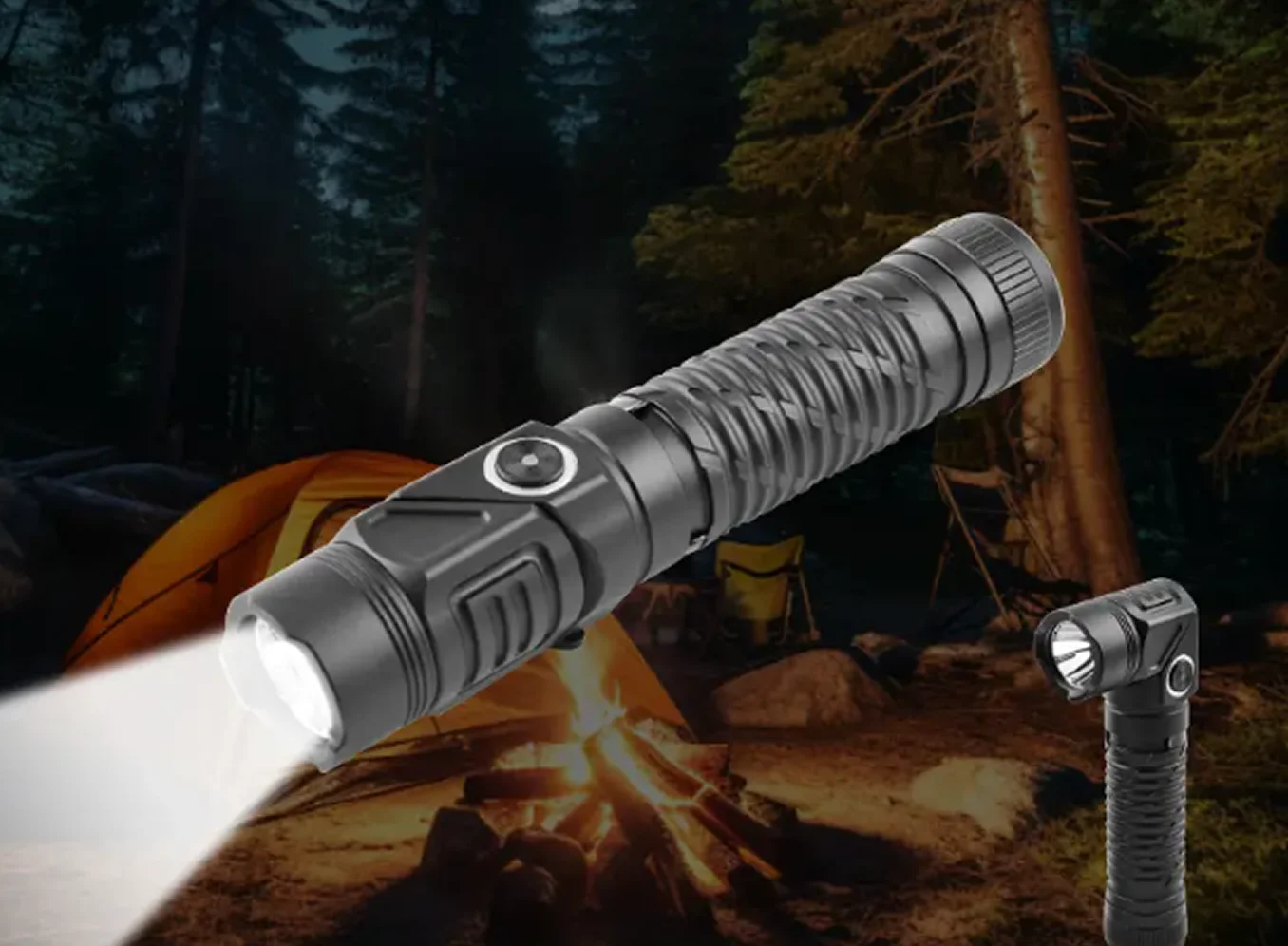
Based on the provided product information, this light fixture is a portable LED flashlight with a right-angle or headlamp-like design. The body is black or dark gray, with an overall metallic feel and a matte to semi-matte finish. Visible components include the main body, tilting head, front lens/reflector, side button, and tail cap. This design suggests it's not just a simple cylindrical lighting tool, but rather a balanced design for both directional lighting and handheld use.
The image also shows a clearly defined grip texture area. This detail is important for actual users, especially outdoors, in humid environments, or when wearing gloves. Combined with the change in beam direction due to the lamp head's tilt, it's more suitable for tasks like "holding it while walking" or "temporarily retrieving it from a toolbox." Its selling points are simple yet clear: small size, strong directionality, single-button operation, and portability.
What problem does a zoom flashlight actually solve?
Many buyers, when looking at zoom flashlights for the first time, will ask a very practical question: Why not just choose a high-powered fixed-beam flashlight? The answer is that the usage environment is not always the same. Fixed spotlights are suitable for seeing at a distance, but when operating at close range, the beam is too small and the contrast between light and dark is too large, which can be uncomfortable for the eyes; fixed floodlights are better for illuminating a range, but the light is not focused enough when searching for targets at a distance.
The zoom mechanism brings these two extremes closer together. For ordinary users, it means being able to clearly see zippers and equipment inside a tent, and having a more focused light on the road ahead when walking at night; for industrial or maintenance users, it means being able to switch more easily between tasks such as wiring, inspecting parts, finding screws, and reading nameplates. To put it simply, zoom flashlights sell the efficiency of "carrying one less light."
Suitable use cases
Based on the stated uses of this product, it is more suited for the following scenarios: tent lighting, camping missions, nighttime walking, vehicle emergency response, toolbox or glove box storage, and close-range operations. In other words, it is a typical general-purpose utility light, not the kind of complex equipment designed only for extreme outdoor adventures or professional law enforcement scenarios.
This type of positioning has its advantages and limitations. The advantages are its versatility and low learning curve; the limitations are that users should not assume it has high-level protection, ultra-long battery life, or special tactical functions, because these parameters are not provided and cannot be assumed based on appearance alone.
Consider these key points when making a purchase.
If you're a sourcing manager or part of a product team, when choosing a zoom LED flashlight, don't just focus on its appearance. Appearance can tell you some things, but the user experience is often determined by the specifications that aren't directly shown in the pictures.
1. Is the beam switching convenient?
The most important aspect of a zoom mechanism is its operability. Whether the zoom is smooth, the positioning is precise, and whether it becomes loose after prolonged use all affect the actual user experience. A structure that is too tight makes one-handed operation awkward; one that is too loose is prone to shifting during transport, affecting the consistency of illumination.
2. The actual balance between low beam and high beam
Many zoom lights share a common problem: when focused, they have a long range, but the edge illumination is too narrow; when floodlit, the range is wide, but the center brightness is not concentrated enough. Buyers need to judge based on their tasks whether they need to "scan the area" or "target the object." For tasks such as maintenance, inspection, or temporary repairs, close-range visibility is usually more important; for tasks such as finding paths at night or observing distant objects, focusing ability is more crucial.
3. Hand feel and anti-slip design
The textured grip area visible in the image is a useful indicator. While flashlights may seem like small items, the real problems often lie not in the light itself, but in the inability to hold them securely, or accidental activation of the switch. Surface treatment, body diameter, button placement, and tail cap structure all need to be considered. Especially if the user wears gloves, the button must be easily accessible without being overly sensitive.
4. Power supply and maintenance methods
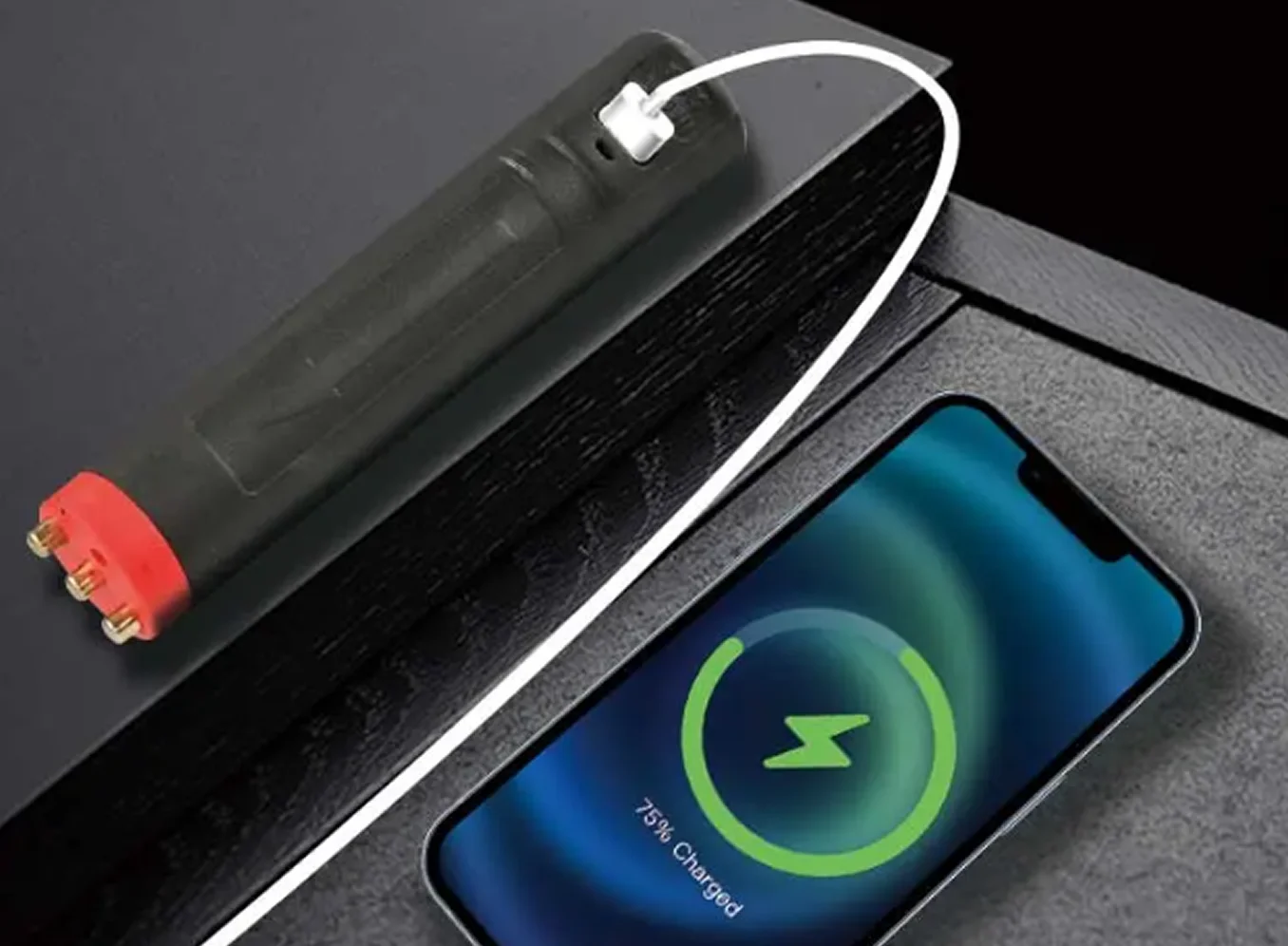
This document does not specify the battery type, charging method, battery life, or whether the battery is replaceable. For the purchasing party, this is an item that must be clarified. The reason is simple: both are portable lights, but rechargeable lights are more suitable for fixed resupply and daily use; replaceable battery lights are more suitable for long-distance travel, emergencies, and environments with unstable resupply. There is no absolute superiority or inferiority between the two, only whether they are suitable for on-site management.
5. Environmental adaptability
Waterproof rating, drop resistance, and weather resistance are not provided, so it should not be used as heavy outdoor gear. For camping or vehicle emergency use, users certainly want it to withstand weather changes, but it's best to clearly state the actual usage environment when purchasing: is it for occasional rain, long-term outdoor use, or mainly kept in a tool bag as a backup? Different scenarios have very different structural requirements.
Why is the right-angle structure worth paying attention to?
A distinctive feature of this product is its right-angled head. This design isn't new in lighting tools, but there's always been a consistent demand for it. The reason is practical: it allows for greater flexibility in how the light is directed—forward, downward, or to the side—making it especially suitable for directional lighting when handheld or placed. Compared to a regular straight flashlight, it's easier to aim at a target in certain positions; and compared to a headlamp, it retains more freedom of handheld control.
For nighttime maintenance, camping desktop lighting, and temporary garage work, right-angle flashlights are often more convenient than people imagine. They don't require headrest mounting or clamps; they're ready to use right out of the box. However, it's worth noting that if users truly need to free their hands for extended periods, a headlamp is still a more direct solution. Right-angle flashlights are more of a compromise, offering both handheld and temporary support.
Common misconception: Don't treat zoom as a one-stop solution.
There's sometimes an overemphasis on zoom LED flashlights in the market, as if simply having zoom functionality solves all lighting needs. This isn't the case. Zoom improves beam shape, but it doesn't automatically address brightness distribution, battery life management, heat dissipation, or durability. If the internal LEDs, optics, and heat dissipation design are weak, a zoom mechanism can actually complicate the user experience.
Another common misconception is equating a "heavier-looking" product with "more professional." While this product may indeed have a metallic and structural feel, the specifications of its internal components cannot be determined solely from a picture. The safest approach when purchasing is to consider the appearance, functionality, testing information, and actual samples together, rather than relying on just a rendering or display image.
Practical advice for buyers
If you're working on inventory preparation, product selection, or gift projects, this type of flashlight is advantageous because it's versatile, easy to understand, and relatively easy to explain to end users. For distribution channels, it's also suitable for bundled sales as a car emergency accessory, camping accessory, or tool kit supplement. To increase conversion rates, the product description should clearly explain features such as "adjustable beam," "directional lighting," "portable design," and "one-button control," while avoiding exaggerating unconfirmed performance claims.
If you're dealing with a more specialized procurement scenario, it's recommended to first confirm four things: whether the beam adjustment is stable, whether the illumination mode is clear enough, whether the power supply method facilitates restocking, and whether the structure is suitable for the target environment. Many lighting fixtures fail not because of the LED chips, but because of inadequate attention to detail in daily use.
FAQ: Frequently Asked Questions Before Purchasing
Is this type of flashlight suitable for outdoor use?
Suitable for everyday outdoor, camping, and emergency use, but whether it is suitable for long-term, complex outdoor environments depends on its protection level, battery life, and structural strength, which are currently not available.
What is the biggest difference between a zoom flashlight and a regular flashlight?
The biggest difference is that the beam is adjustable. Zoom lights can switch between more focused and more diffused lighting, making them more suitable for users who need to switch between multiple tasks.
What are the advantages of a right-corner design?
It is better suited for directional lighting and temporary placement, and it is also easy to adjust the beam angle in various positions. It is especially useful for tool kits, vehicle-mounted applications, and maintenance scenarios.
Is it possible to decide on a purchase based solely on appearance?
Not recommended. The appearance can give you a general idea of its intended use, but it can't replace key specifications. At the very least, you should clarify the brightness, power supply, battery life, protection, switch lifespan, and zoom feel.
What should be done next?
If you're evaluating this type of product, the next step isn't to rush into placing an order, but to clearly define the application scenario. Is it for campers, vehicle emergency kits, or tool retailers? Is it geared towards handheld inspections or temporary nighttime lighting? Different targets require different structural focuses for the light.
For purchasing and product teams, the most effective approach is to first confirm the sample, and then check if the zoom smoothness, button feel, grip comfort, and overall build quality match the target market. As long as these basic aspects are satisfactory, zoom LED flashlights can often become a stable, easily explained, and readily accepted practical product category. As for more detailed parameters, it's best to leave them for formal sample testing and supplier confirmation stages, rather than relying on guesswork.