Rechargeable LED flashlights: Powerful battery, high efficiency and reliability—why you shouldn't just look at how bright they are when purchasing them.
When choosing rechargeable LED flashlights—products known for their powerful performance and high reliability—many buyers first focus on the brightness rating and then the price. However, what truly determines the user experience is not simply whether it "brightens," but rather its ability to provide stable illumination in scenarios such as power outages, inspections, nighttime operations, and outdoor maintenance; its ease of recharging; and its reliability after repeated charging and discharging. For engineers, purchasing managers, and product teams, these questions are more important than mere lumen output claims.
If a flashlight is only used occasionally at home, the selection is plentiful; however, things become more complex once you enter the B2B procurement context. You need to consider the power supply method, shell structure, charging interface, assembly method, ease of maintenance, and even whether it is suitable for OEM/ODM customization. Especially for products with structures such as charging cables, contact pins, and viewing windows, what appears to be just a portable lighting device may actually correspond to a more complete electronic module or power supply component solution. Buying the wrong one usually leads to problems not just that the "light doesn't work," but rather increased maintenance costs, higher return rates, and a concentration of user complaints.
First, understand clearly: what problem do these products actually solve?
The core value of rechargeable LED flashlights lies not only in saving disposable batteries. Its more significant meaning is transforming lighting equipment from a "consumable" into a "reusable tool." This is crucial for scenarios such as warehousing, property management, security, maintenance, inspection, and service vehicle spare parts. You don't need to frequently change batteries, nor do you need to worry about temporarily not being able to procure suitable dry-cell batteries. As long as the charging path is stable, the device can be used continuously.
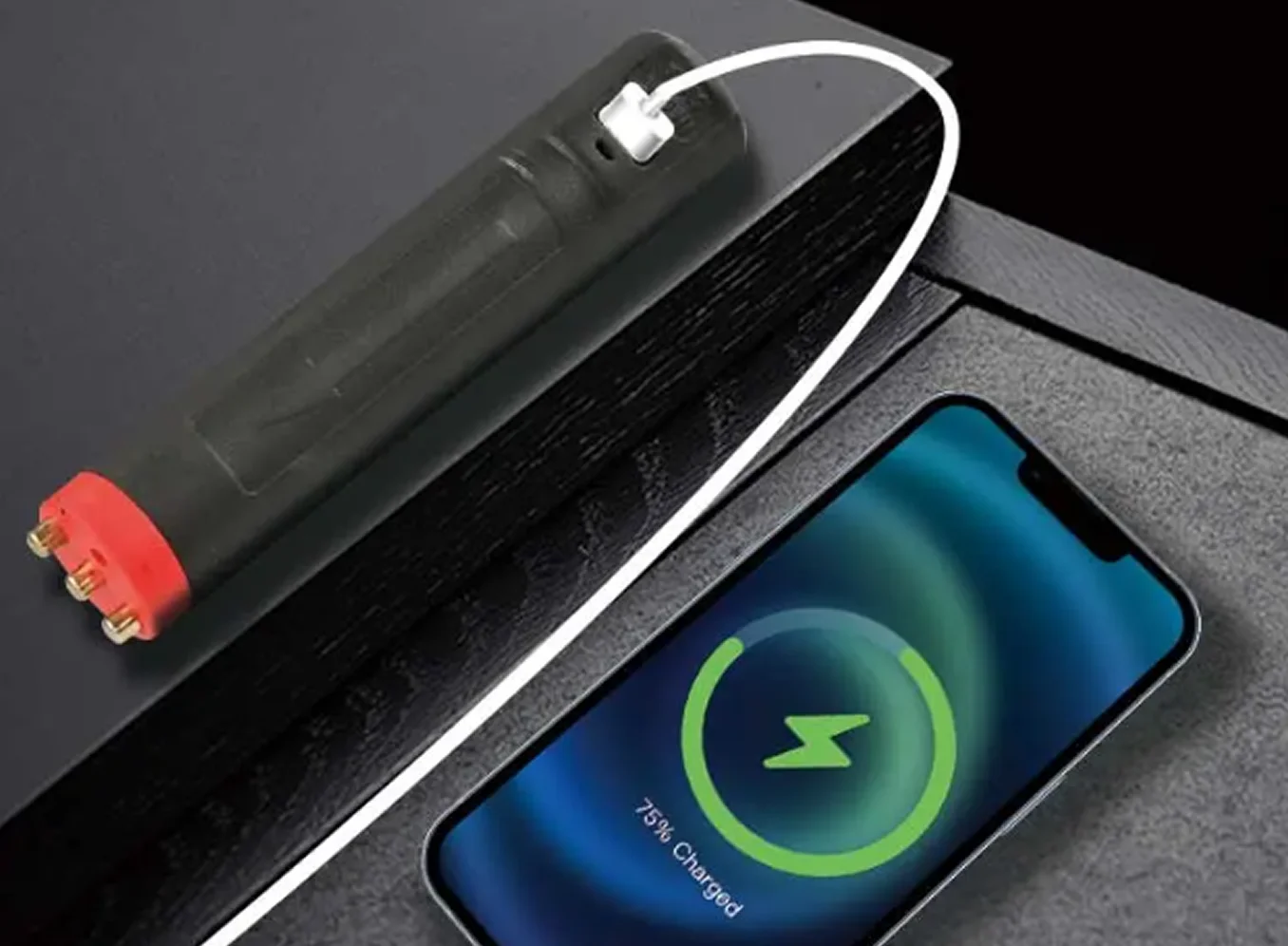
Based on the product information you provided, this product presents a long, cylindrical, handheld electronic structure with a black casing, a transparent side window, a red end cap, and three visible gold contact pins. A white charging cable connects to the interface at the top. The image also shows a mobile phone charging interface; this type of display usually emphasizes its "rechargeable" or "power-related" function. It's important to note that an image alone cannot equate to a finished product with a specific function, but it at least confirms that it is an electronic device with external charging capability and clearly exhibits contact-based power supply characteristics.
What you should focus on most when purchasing is not the first line of the parameter table.
Many buyers focus on terms like "brightness," "battery life," and "fast charging," which is not wrong, but it's not enough. Especially for lighting products with charging mechanisms, the following factors truly influence bulk purchasing decisions.
1. Does the charging method match your usage environment?
For office, warehouse, or fixed workstation settings, wired charging is usually fine. However, for vehicle-mounted, mobile repair, or outdoor environments, the interface location, plug-and-play feel, and cable durability become very important. The structure shown in the image, with an external cable and contact pins, seems more like a fixed charging or dock-based contact charging system. Its advantage is its simplicity, but its disadvantages are also obvious: if the contact points accumulate dust, oxidize, or experience uneven stress over time, charging stability may decrease. It's best to confirm beforehand whether this structure facilitates daily maintenance.
2. Is the outer casing structure suitable for repeated handling?
A flashlight isn't a display item; it's a tool that will be handled, placed, dropped, and squeezed. The product you provided appears to have an injection-molded plastic casing with a matte finish, featuring partial transparent windows and metal contacts. This type of structure is common in mass production, offering advantages such as controllable costs, high molding efficiency, and ease of appearance differentiation. However, buyers should pay attention to the mechanical strength of the seams, end cap locations, and interface areas. Many problems don't stem from the LED itself, but rather from loose casing, fatigued clips, or cable tension.
3. Does the viewport have any practical significance?
Transparent side windows are common in lighting products, used to display light source status, enhance visual appeal, or serve as light strips/indicator areas. While seemingly simple, poorly placed windows can easily lead to problems like water ingress, yellowing, and scratches. For products targeted at industrial or service sectors, appearance is important, but durability is always more crucial than simply looking "high-tech." It's especially important to note: if a transparent component is only for visual appeal, don't use it as a performance selling point; if it serves an indicator function, ensure readability and visibility under ambient light.
From a manufacturing perspective, how are these types of products typically made?
While the images are insufficient to confirm the specific model, its structure suggests it resembles a typical assembled product consisting of a plastic injection-molded casing and internal electronic components. This manufacturing process is common in consumer electronics and small gadgets: first, the casing is injection-molded; then, the LED board, power module, charging components, and contacts are assembled; finally, final assembly and testing are completed. For the buyer, this translates to supplier stability, often reflected not only in circuit design but also in casing consistency, assembly cycle time, and interface tolerance control.
If you're doing brand customization or project implementation, it's recommended to focus on asking three key questions: First, are the shell material and surface treatment suitable for long-term grip? Second, is the assembly method of the charging port and contact pins reusable? Third, is the internal structure of the lamp body easy to repair or replace modules later? Many samples may look perfect, but once mass production begins, poor maintainability will quickly amplify after-sales costs. These kinds of issues may not be immediately apparent, but they are the most likely to cause headaches for the purchasing team later.
How to determine if a rechargeable LED flashlight is suitable for your needs?
If you're making a selection, it's best not to treat it as a standalone product, but rather as part of a "lighting solution" for evaluation. The focus will vary greatly depending on the scenario.
Suitable for priority scenarios
Warehouse inventory checks, nighttime security, equipment inspections, property emergency response, vehicle tool kits, and backstage lighting for exhibitions and events—these scenarios typically prioritize portability, rapid charging, and stable supply. For these applications, rechargeable solutions offer greater long-term economic viability than disposable batteries and are easier to standardize.
Scenarios requiring caution
If your application involves frequent rain, dust, chemicals, or heavy impacts, then simply looking at "rechargeable" isn't enough. You also need to consider protection, sealing, grip stability, and interface reliability. Charging structures with contact pins, while simple, are particularly sensitive to environmental cleanliness. Even the best lighting performance will suffer if the charging contact is unstable, affecting the overall rating.
Several common mistakes buyers make
The first mistake is focusing solely on brightness while ignoring battery life logic. High brightness doesn't guarantee all-night reliability, especially without specifying battery output, drive circuitry, and heat dissipation design. The second mistake is neglecting the interface and cable. The white charging cable in the picture may seem like an accessory, but in real-world use, it often determines ease of use and failure rate. The third mistake is equating sample performance directly with mass production performance. Samples can be manually adjusted, but mass production involves consistency, packaging, shipping, and after-sales service.
Another easily overlooked point: if the product is intended for internal distribution within a company, it's best to standardize the charging method and accessory specifications in advance. Purchasing different versions piecemeal will result in a pile of incompatible cables and bases, leading to high management costs. This issue may seem trivial, but it's actually the most manpower-intensive.
If you are doing OEM/ODM, what conditions should you lock in in advance?
For buyers looking to brand or integrate projects, it's recommended to confirm the appearance, charging interface, button logic, indicator methods, and packaging as early as possible. The structure shown in the image, with contact pins and external wiring, indicates that it's not a simple "plug and play" component, but rather an electronic product with a clearly defined power connection and assembly logic. Therefore, if customization is needed later, it's best to clearly specify the structural components, wiring, labeling, and packaging in one go to avoid repeated prototyping.
Another practical piece of advice is not to mistake "can be done" for "suitable to be done." Some structures are perfectly suited to OEM solutions, but may not be suitable for your brand positioning. For example, if you want to make high-end emergency tools, the appearance of seams, the degree of interface exposure, and the texture of the lamp body are very important; if you want to make high-turnover tooling, durability and ease of maintenance will be priorities. Different positioning cannot be judged by the same set of standards.
Practical advice for purchasing and product teams
If you're currently screening rechargeable lighting products, it's recommended to first write down your needs in three sentences: What is the usage scenario? How will you typically charge it daily? Who will maintain it if there are any problems? Clearly defining these three points will naturally resolve many seemingly complex selection debates. Then, examine the sample's casing, interfaces, lamp placement, and accessories. Reversing this order often leads to being swayed by appearances.
At the same time, don't overlook whether the supplier can provide stable assembly and replenishment capabilities. For B2B, the completeness of a single sample is far less important than continuous supply. Especially for products with charging structures and contacts, accessory compatibility, replacement part consistency, and subsequent maintenance support all directly impact the total cost of ownership.
Frequently Asked Questions
Are these types of products always suitable for outdoor use?
Not necessarily. Whether it's suitable for outdoor use depends on the interface protection, casing strength, and long-term weather resistance. A conclusion cannot be drawn solely based on whether it's "rechargeable."
Does seeing a phone charging screen mean it can power the phone?
That's not a valid judgment. The phone screen in the picture looks more like a display of a charging theme or marketing scenario, and cannot replace actual compatibility proof.
Are structures with contact pins more prone to problems?
Its advantages are simple operation and clear positioning, but it is more sensitive to contact cleaning and assembly consistency. Whether it is suitable for your project depends on the frequency of use and the environment.
What should be done next?
If you're evaluating a rechargeable LED flashlight, the next step isn't to place an order immediately. Instead, first confirm its charging method, housing structure, interface type, and maintenance path before deciding if it's suitable for your needs. This step is especially important for teams that need to make bulk purchases, distribute through channels, or customize for OEM. Treating samples as "samples to verify the structure and usage logic," rather than the final answer, will usually save you a lot of trouble.
If you'd like, I can further refine this content into a format suitable for product pages, purchasing guides, or English versions of corporate blogs, making it easy for you to publish directly on your official website.